
Last updated November 17, 2026
 Wrought iron
 Wood & steel frame
 Farm & ranch
 Sliding driveway gates
 LiftMaster operators
Free on-site gate assessment - hinges, posts, and your LiftMaster or Nice gate operator checked before anything is quoted
The assessment is free and the quote is the invoice.
Get your free estimateHow Long Does Gate Parts & Welding Take? Timelines and What to Expect
A simple hinge weld takes about 20 minutes of actual arc time. The same repair on a gate with rust-contaminated base metal that has to be ground back to clean steel first can run two hours, minimum. Nobody on the phone can tell you which one you have until they’re standing in front of the gate with a grinder in hand. That gap between the phone estimate and the real job is where most people get surprised, and it’s what this guide is here to close. We’ll walk through honest timelines for the welding repairs we see most across North Las Vegas, why rust prep so often outlasts the weld itself, and the questions that force an accurate estimate instead of a guess.
Quick Answer
Most gate welding repairs take between 1 and 4 hours of on-site labor per repair, with hinge plate repairs at the low end and full hinge replacement or post-collar reinforcement at the high end. Total turnaround, from call to finished gate, is usually 1 to 3 days when hardware is in stock and up to 2 weeks when a specialty part has to be ordered for ornamental iron or older wrought iron gates. Rust, gate weight, and parts sourcing are the three variables that move that number most.
Styles & brands we work with
- Wrought iron
- Wood & steel frame
- Farm & ranch
- Sliding driveway gates
- LiftMaster operators
Table of Contents
- Arc Time vs. Job Time: Why the Weld Is the Short Part
- How Long Do the Most Common Gate Welding Jobs Take?
- Why Rust Prep Takes Longer Than the Weld
- How Gate Size and Weight Multiply Labor
- Parts Sourcing: Iron, Steel, and What’s Actually Stocked
- How to Get an Estimate That Reflects Condition, Not Category
- When Welding Meets Motors, Hinges, and Access Control
Arc Time vs. Job Time: Why the Weld Is the Short Part
People hear “weld” and picture sparks and a bead of molten metal. That part is fast. What eats the clock is everything around it. Grinding the joint clean, clamping the gate so it can’t shift while you weld, waiting for the metal to cool enough that you can handle it, then treating the exposed steel so the rust doesn’t come back next spring. In our experience, the actual arc time on a hinge plate repair is often 15 to 20 percent of the total job.
The rest is setup and finish. Here’s how the hours typically break down on a standard repair:
- Assessment and setup: 10 to 25 minutes – checking the gate swing, identifying where the failure actually originates, staging tools and a power source
- Prep and grinding: 15 minutes to over an hour – depends entirely on how much rust, paint, or old weld has to come off first
- Arc time: 15 to 45 minutes for most common repairs
- Cool-down: 10 to 30 minutes – you don’t rush hot metal, and you don’t spray water on a freshly welded hinge to speed it up
- Rust treatment and refinish: 15 to 45 minutes, sometimes longer if the whole gate needs attention
- Re-hang and test swing: 10 to 20 minutes
That’s why a North Las Vegas homeowner who calls about a “20-minute weld” and gets a two-hour window isn’t being upsold. The extra time is the difference between a repair that holds for years and one that cracks again by the next monsoon season. Our technicians have up to 25 years of experience, and the single most common thing they see on a gate that failed a second time is a weld laid over rust instead of clean metal.
If you’re looking at the bigger picture of what’s failing on your gate, our Gate Repair in North Las Vegas page covers the diagnosis side in more depth.
How Long Do the Most Common Gate Welding Jobs Take?
These are honest ranges, not promises. The lower end assumes clean metal and easy access. The upper end assumes you’ll find rust or a warped frame once the gate is open and clamped.
- Hinge plate repair: 1 to 2.5 hours. The most common job we do. A hinge plate cracks or fatigues where it meets the frame, especially on gates over 8 feet. Weld prep and rust treatment drive the variance.
- Frame crack repair: 1.5 to 3 hours. Cracks usually show up near the hinge post or where a rail meets a stile. If the crack runs along a stress point, we brace the frame before welding so it doesn’t pull out of square.
- Post collar reinforcement: 2 to 3.5 hours. This reinforces where the gate post meets the ground and takes longer because the post often has to be stabilized first. Sag in a gate usually traces back to the hinge post, not the middle, so this is where we start.
- Full hinge replacement: 2.5 to 4 hours. Cutting out the old hinge, aligning the new one, welding it true, and re-testing the swing. On a heavy gate this can stretch to a full afternoon.
- Full gate rebuild or major frame reconstruction: half a day to a full day, sometimes more if new stock has to be cut and fitted.
Add 30 to 60 minutes if the gate is on a slope or if the power source is a long run from the driveway. Add another hour or more if the gate has to be taken off its hinges first to work on it safely. In North Las Vegas, gates set into block walls on sloped lots are common and add handling time.
Why Rust Prep Takes Longer Than the Weld
This is the part most people underbudget for. Rust doesn’t just sit on the surface. It eats into the base metal, and welding over rust-contaminated steel produces a weak, porous bead that fails fast. So before any arc time, we grind back to sound metal, and that takes as long as it takes.
In North Las Vegas, we see a specific pattern. The dry climate slows rust on exposed surfaces, but sprinkler overspray, pool splash, and gates near washed gravel beds trap moisture at the hinges and at the base of the post. That’s where the deep rust hides. A gate that looks clean standing upright can have a hinge plate half-eaten underneath. On the flip side, our dry summer heat makes paint and powder coat crack faster on south-facing gates, which means moisture gets in and rust starts underneath the coating.
Rust prep usually runs 20 minutes on a well-kept gate and well over an hour on a gate that’s been neglected for a few seasons. Skipping it to save money is the one shortcut that always comes back. A weld laid over rust looks fine for a few months, then cracks, and the next repair costs more because there’s now a bad weld to grind off too.
What rust treatment actually involves
- Grind the joint and surrounding metal down to clean, bright steel.
- Remove loose scale and any flaking old weld with a chipping hammer or wire wheel.
- Weld the repair.
- Let it cool, then treat the exposed steel with a rust converter or primer before paint.
- Repaint or touch up the finish coat so the repair matches the rest of the gate.
Step four is where people ask “can we skip that?” We don’t. The rust converter is the reason the repair lasts through the next rainy season instead of failing by fall.
How Gate Size and Weight Multiply Labor
A 4-foot pedestrian gate that weighs 60 pounds can be lifted, clamped, and worked on by one person. A 12-foot double gate with a steel frame and iron pickets can weigh several hundred pounds. Once the gate is that heavy, the job changes shape entirely.
- Repositioning. Heavy gates often have to come off the hinges, get braced, and be re-hung after welding. That alone adds 45 minutes to an hour or more.
- Alignment. A heavy gate that’s welded off-square won’t close right, so the frame gets braced and checked at multiple points during welding.
- Two-person minimum. Anything over roughly 200 pounds means two sets of hands on site, which affects scheduling.
- Post support. On a heavy gate, the hinge post often has to be reinforced at the same time. A hinge repair on a heavy gate is rarely just a hinge repair.
If you’re weighing repair against replacement on a large gate, our Gate Installation in North Las Vegas page walks through when a new gate actually makes more sense than another repair. In our experience, most gates are repairable far longer than their owners think.
Parts Sourcing: Iron, Steel, and What’s Actually Stocked
The weld itself is often the fast part. Waiting for the right hinge, bracket, or picket can add days. What’s stocked locally depends heavily on the gate’s material.
Ornamental iron and wrought iron
Ornamental iron gates are typically made of standard stock sizes, so most hinge plates, scrolls, and pickets can be matched locally or swapped for a close match. Older wrought iron gates are a different animal. Wrought iron is a lower-carbon, more ductile material than modern steel, and specialty forged pieces (curls, finials, decorative brackets) are not stocked. They have to be ordered or custom-fabricated, and that can add 3 to 10 days to the job.
Tubular steel
Tubular steel is the most forgiving to repair and the most commonly stocked. Wall thickness does matter for repair quality, though. Thin-wall tubular gates are common at the lower end of the market and are harder to weld without burning through, so the repair takes more care even when the material is stocked.
Cast iron and aluminum
Cast iron is brittle and prone to cracking at stress points. Welding cast iron is a specialist job and typically means a longer timeline than the customer expects. Aluminum gates don’t weld with standard steel equipment; they need different filler and different handling. If your gate is aluminum, expect the timeline to be closer to the high end of any range.
Access control and automation hardware
If the repair involves operator hardware, many components for Viking, Ghost Controls, DoorKing, and Elite are stocked or quickly available. The Gate Motor & Opener in North Las Vegas page covers what’s involved when the repair crosses into automation.
How to Get an Estimate That Reflects Condition, Not Category
The reason phone estimates are often wrong is simple: the person quoting hasn’t seen the gate. A repair category like “hinge plate weld” has a huge range depending on the metal underneath, and no honest contractor can carve that range down without looking. Here’s how to get an estimate that actually holds up.
- Describe the material. Steel, iron, wrought iron, aluminum, or cast iron. If you don’t know, look for rust color (brown flaking points to steel or iron), weight (cast iron is heavy and brittle), and whether the surface has paint or powder coat.
- Describe the age of the gate. A gate under 5 years old tends to still have clean metal at the joints. A 20-year-old gate usually doesn’t.
- Take a photo of the actual failure point. Close-up, in good light, from a couple of angles. A photo of a rusted hinge plate tells a much better story than “my hinge is loose.”
- Mention the gate’s size and weight as best you can. Height and width help set the labor estimate.
- Say whether the gate still opens and closes on its own, or whether it’s stuck. A stuck gate usually needs more structural work than a gate that still operates.
- Ask what the estimate assumes. A contractor who is willing to say “this estimate assumes no deep rust at the hinge” is giving you a real number. A quote with no stated assumptions is usually a guess.
- Ask for the estimate in writing before work starts. The price should be quoted and agreed before any welding begins, not discussed after the gate is already on the ground.
A site visit that takes 15 minutes can turn a shaky estimate into an accurate one. That’s not overhead. It’s the reason the number holds.
When Welding Meets Motors, Hinges, and Access Control
Some jobs start as welding and turn into something broader. A gate that sags enough to fail a hinge weld may also be straining the operator or pulling the access control arm out of alignment. When that’s the case, the timeline is set by the widest part of the job, not the welding alone.
Common crossover jobs we see in North Las Vegas:
- A hinge weld on a gate that also needs its operator re-leveled. Roughly 3 to 4 hours.
- A post collar reinforcement on a security gate that has an access control arm attached. Roughly 3 to 5 hours, since the arm has to come off and go back on.
- A full hinge replacement that also requires a new set of hinges, a new closer, or a rebuilt post anchor. Half a day to a full day.
When the job reaches that size, scheduling matters more than speed. That’s normal. The one thing that shouldn’t stretch is the response when you call. A live person answers every call at Gatewood Fence & Gate, day or night, so you’re talking to someone who can actually schedule the work instead of a voicemail. If you’d rather see the whole picture first, our Gatewood Fence & Gate North Las Vegas home page lays out everything we handle.
Common Mistakes to Avoid
- Assuming a phone estimate is final. A quote given without seeing the gate is a guess with a number attached. Ask for a written estimate based on a site visit, and confirm the price before welding starts.
- Skipping rust prep to save money. A weld over rust fails within months, and the next repair costs more because there’s a bad weld to grind off first. The prep is what makes the repair last.
- Repainting too soon. Paint applied to weld that hasn’t fully cooled cracks and traps moisture. Give the metal time to cool and the treatment time to cure.
- Repairing the hinge without checking the post. In North Las Vegas, most sagging gates trace back to the hinge post, not the hinge itself. Fix the panel without the post and you’ll fix it twice.
- Hiring someone who won’t show a published address and license. If the name on the truck doesn’t match the name on the paperwork, you have no recourse if something goes wrong.
- Ignoring a gate that closes on its own. A gate that drifts shut is telling you the hinge or the post is out of alignment. Waiting means the eventual repair gets bigger.
- Ordering parts before the failure is diagnosed. Specialty hardware ordered for the wrong failure point becomes scrap. Diagnose first, then source.
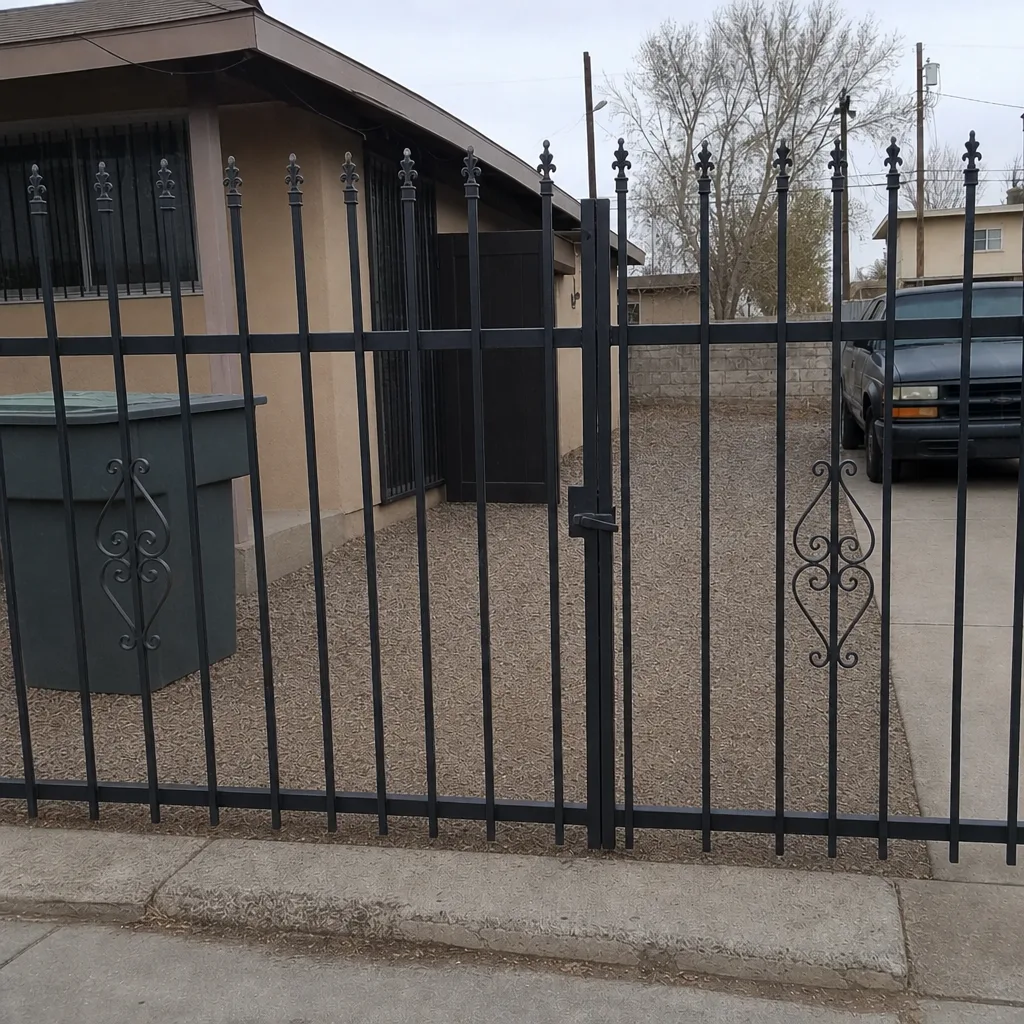
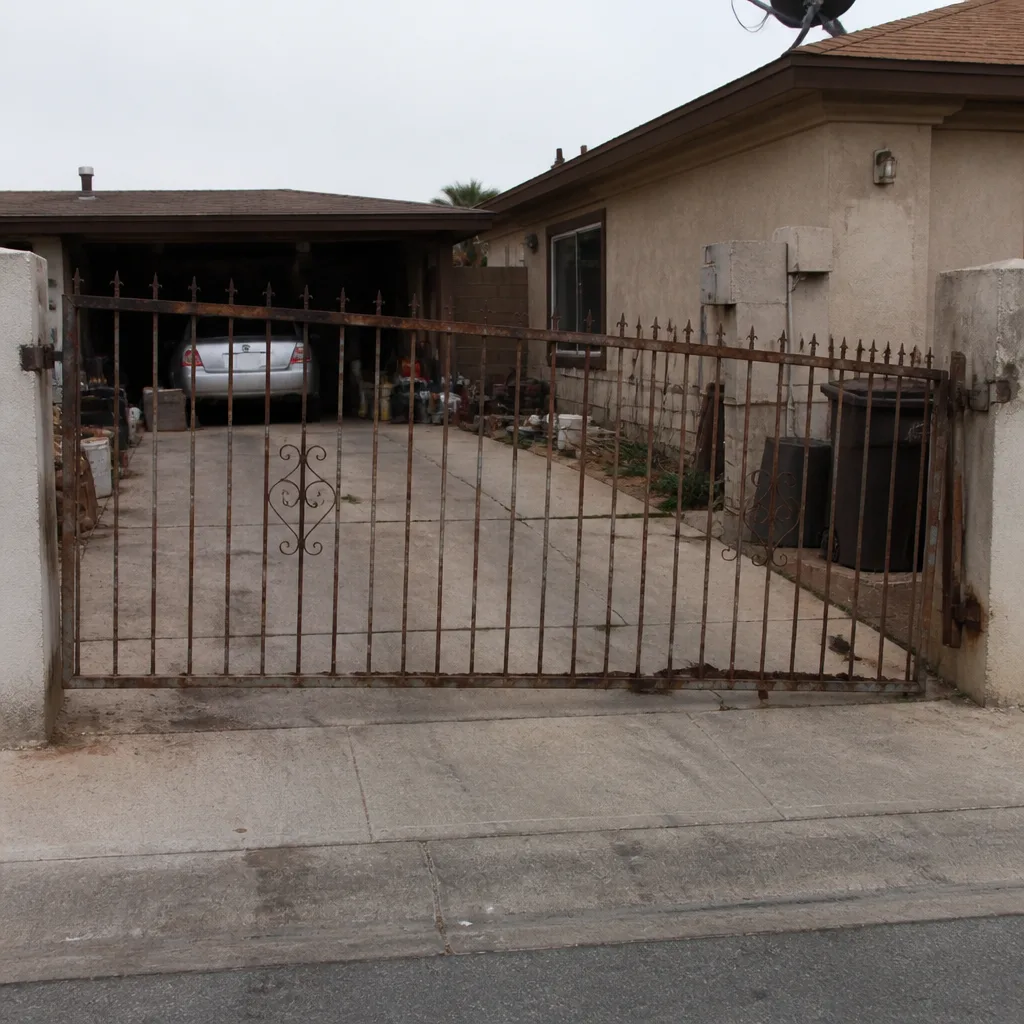
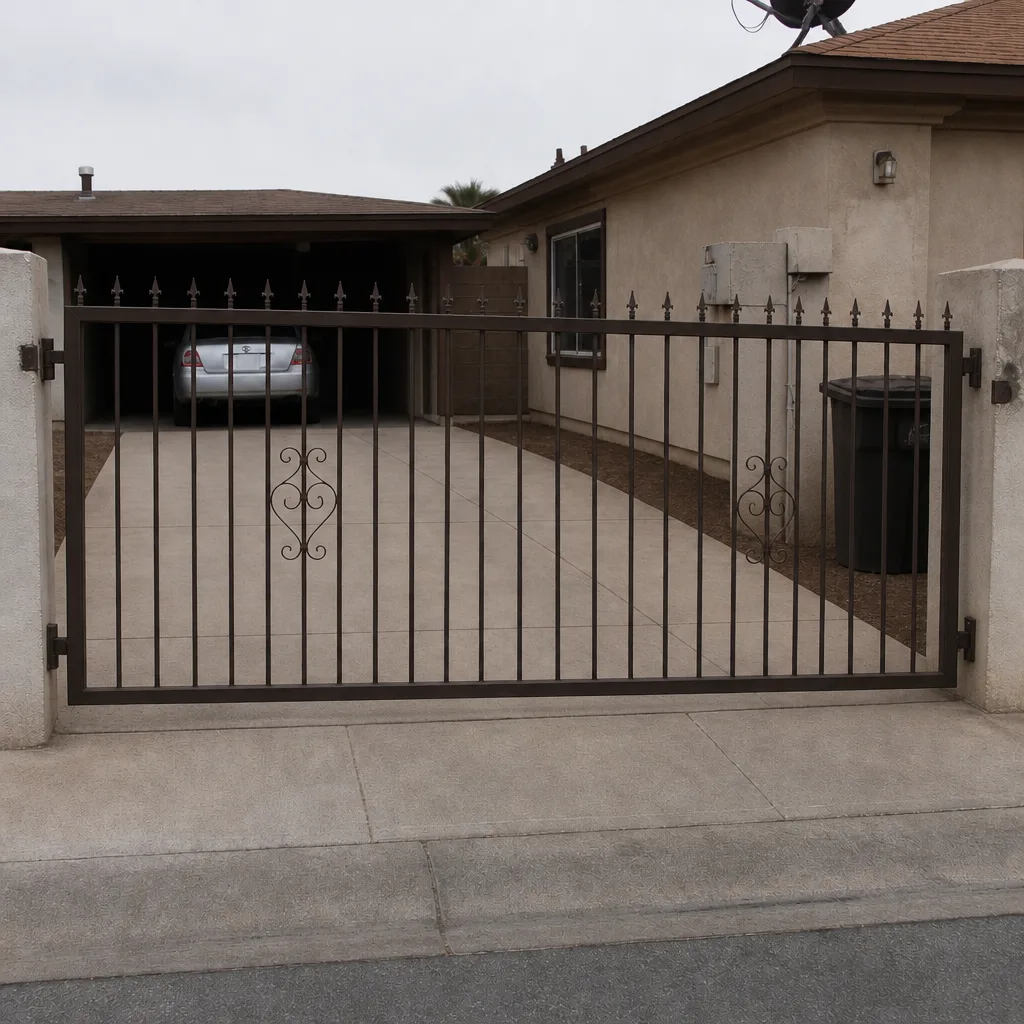
See the difference
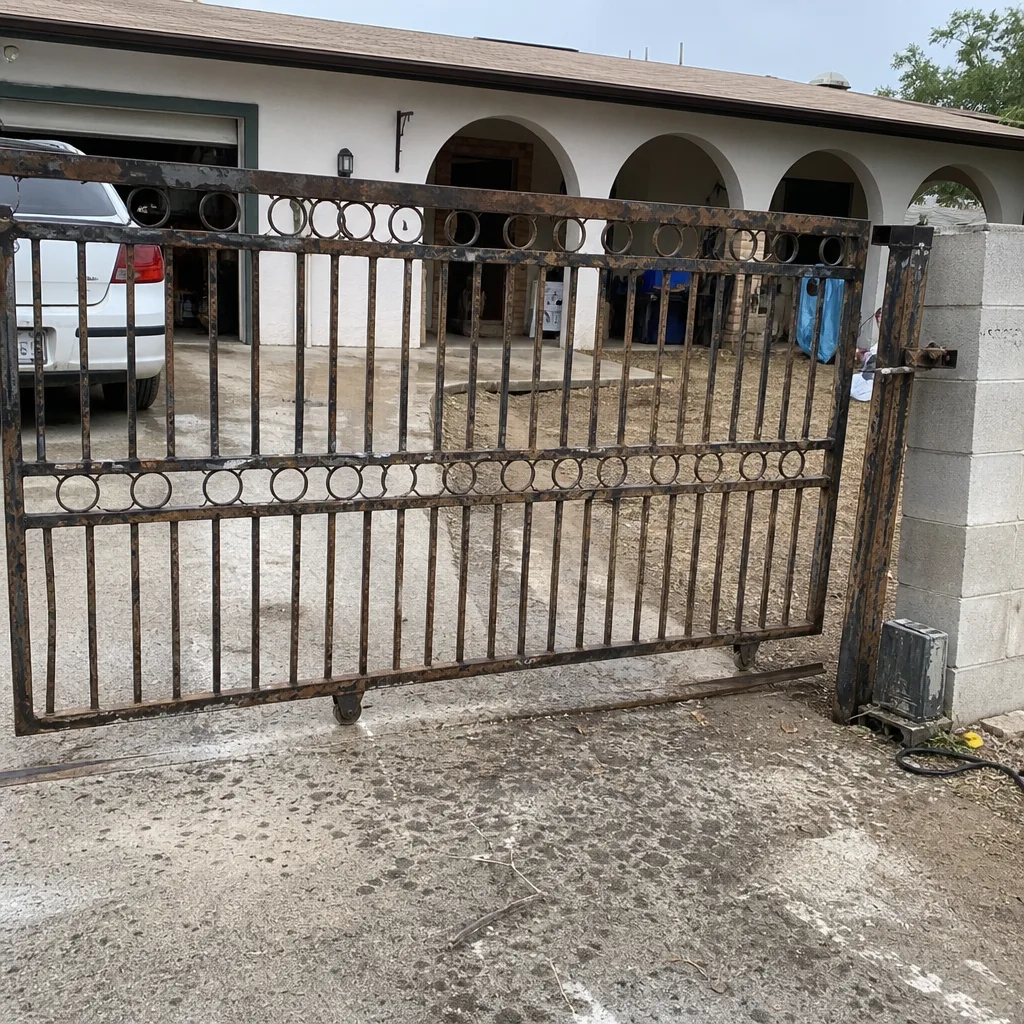 Before
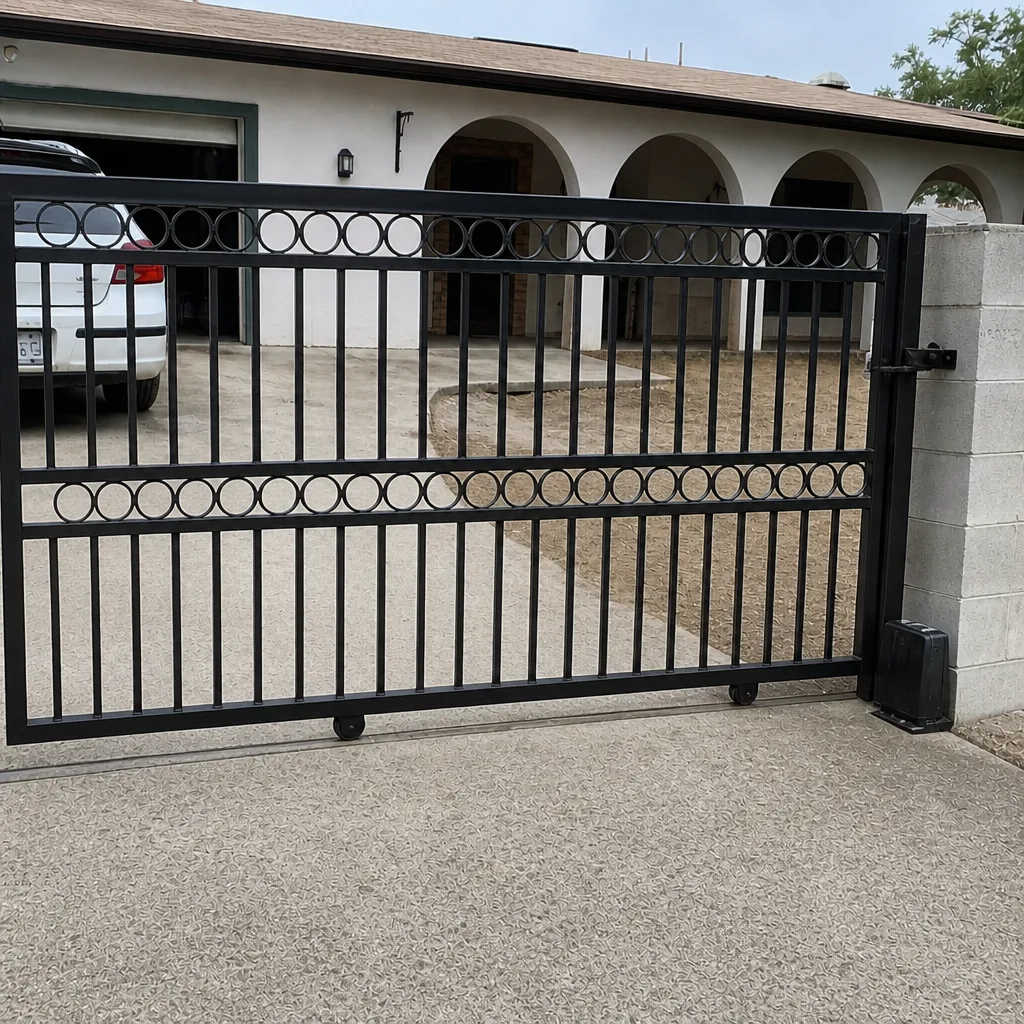 After
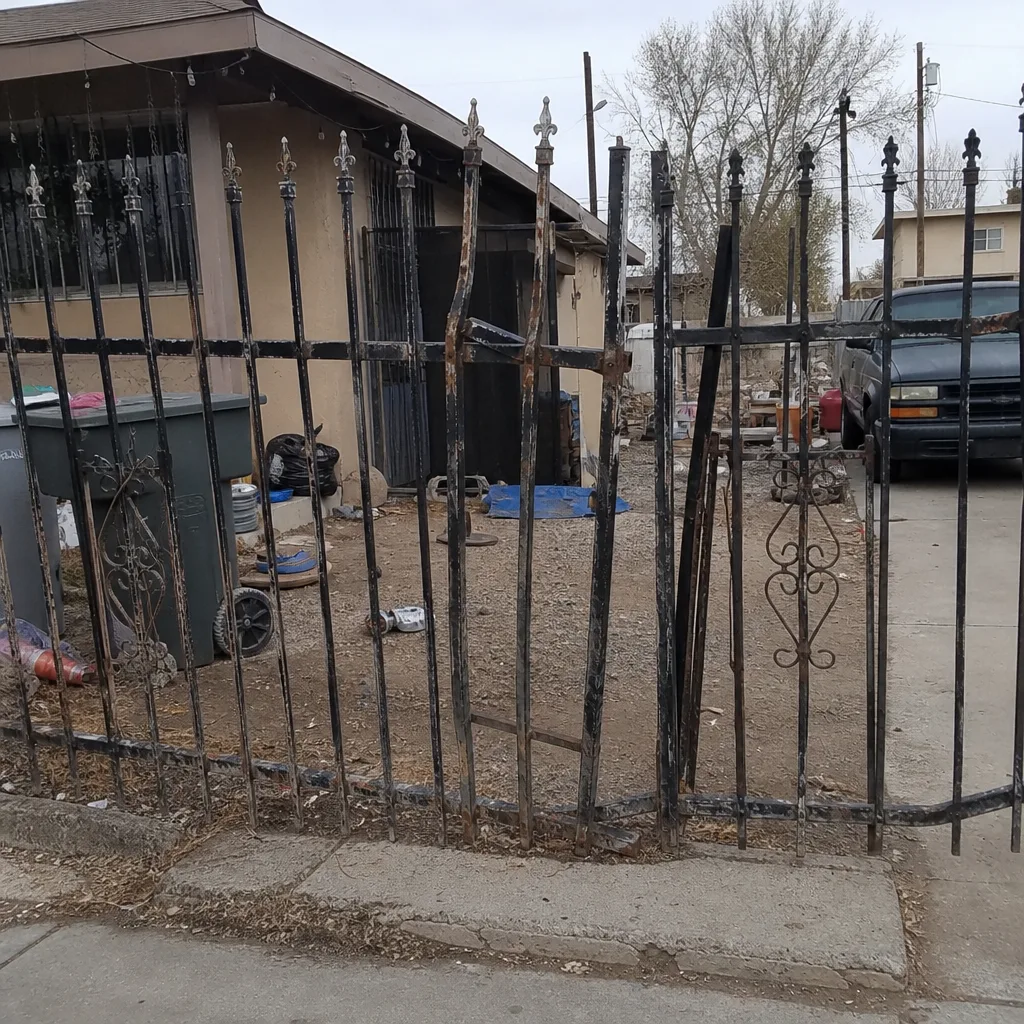 Before
 After
 Before
 After
When to Call a Professional
Call a professional the moment the gate stops latching, the hinge plate is visibly cracked, or the gate swings on its own. Those are warnings, not cosmetic issues. Also call if you see rust bubbling through paint at a hinge or post – it usually means the metal underneath is far gone. Do not attempt to weld a gate that’s already hanging on a strained post; the failure can happen while you’re under it. If the gate is motorized or tied to access control, always call a pro, since the metal repair and the operator need to be handled together. Gatewood Fence & Gate North Las Vegas offers free estimates in North Las Vegas – call (844) 761-9351. We answer live, day or night, and the 90-Day Done Right Promise is stamped on every job in writing.
Frequently Asked Questions
Most gate welding repairs take 1 to 4 hours of on-site labor per repair, and total turnaround from call to finished gate is usually 1 to 3 days when parts are in stock. Full hinge replacement and major frame repair sit at the high end; hinge plate repair sits at the low end. Call (844) 761-9351 for an exact quote – estimates are free, and we’ll tell you the real range once we’ve seen the gate.
Same-day repair is possible on straightforward jobs when the failure is clean and the right hardware is on hand, but we won’t promise it over the phone. Rust, gate weight, and parts availability can each turn a quick job into a longer one. We’ll tell you what’s realistic when we assess the gate. Call (844) 761-9351 for a live answer and an honest window.
Grinding back to clean metal takes as long as it takes – sometimes an hour or more on a gate that’s been neglected. Welding over rust produces a weak bead that cracks within months, so skipping prep just moves the cost to the next repair. It’s the slowest part of the job and the one that decides how long the fix lasts.
We service nine major gate brands, including Viking, Ghost Controls, DoorKing, and Elite, so common operator and hardware parts are typically available quickly. Decorative wrought iron pieces and unusual forged components often have to be ordered, which can add 3 to 10 days. Tell us the brand and what’s failing, and we’ll tell you what’s realistic.
On-site welding is standard for us. The gate stays in your driveway, which is faster and means we can test the swing on the actual hinges and posts. Hauling a gate off adds real time and money and is rarely necessary. Call (844) 761-9351 and we’ll walk through whether your gate qualifies for on-site repair.
When the repair crosses into a motor or access control system, the timeline is set by the widest part of the job, not the welding alone. A gate that needs a hinge weld and an operator re-level can run 3 to 4 hours. We handle both under one visit where possible. Call (844) 761-9351 for a free estimate.
The Bottom Line
The honest answer to “how long does gate welding take” is: less time than you think for the weld, more time for everything around it. Arc time is 15 to 20 percent of the job. Prep, cool-down, rust treatment, and hardware sourcing make up the rest. Rust prep is never skippable. Gate weight adds handling time that a phone estimate can’t predict. Parts for ornamental iron and old wrought iron can add days. And the only estimate worth trusting is one made after someone has looked at the actual gate, on site, and quoted you in writing before any work starts. If you’re in North Las Vegas and want a real number instead of a guess, that’s a conversation worth having.
Contact Gatewood Fence & Gate North Las Vegas
Give us a call at (844) 761-9351 for a free estimate, and we’ll come look at the gate before we put a number on paper. The 90-Day Done Right Promise is stamped on every job in writing, and every repair comes with no trip charge inside the county, $40 off any repair over $200, a free second opinion on any written estimate, and a permanent 10% discount for seniors and veterans. A live person answers, day or night.
Written by the team at Gatewood Fence & Gate North Las Vegas.