
Last updated November 17, 2026
 Wrought iron
 Wood & steel frame
 Farm & ranch
 Sliding driveway gates
 LiftMaster operators
Free on-site gate assessment - hinges, posts, and your LiftMaster or Nice gate operator checked before anything is quoted
The assessment is free and the quote is the invoice.
Get your free estimateSeasonal Gate Repair Care for North Las Vegas: Year-Round Homeowner’s Guide
The gate calls we get most in November aren’t from summer damage. They’re from operators that sailed through a 115-degree July without a complaint and then faulted on the first cold morning, because nobody had looked at the battery backup in two years. That’s the strange thing about gate care in North Las Vegas: the failure you hear about in winter was usually planted back in April. This guide walks through each phase of the year here, tells you what’s about to break and when, and shows you how a few hours of prep keeps you off the emergency call list.
Quick Answer
Gate care in North Las Vegas runs on a four-phase calendar, not four equal seasons: pre-summer prep in April, monsoon watch from July through September, a fall reset before temperatures drop, and winter checks on batteries and hydraulics once mornings dip below 45°F. Homeowners who do the April and October inspections spend roughly $150 to $300 a year on maintenance and avoid the $400 to $900 repair bills that follow neglect.
Styles & brands we work with
- Wrought iron
- Wood & steel frame
- Farm & ranch
- Sliding driveway gates
- LiftMaster operators
Table of Contents
- Pre-Summer Prep: What to Do in April
- Monsoon Season: Dust, Moisture, and the Corrosion Spike
- The Fall Reset That Adds Years to Your Operator
- Winter in North Las Vegas: Batteries, Hydraulics, and Caliche
- Maintenance vs. Repair: A Realistic Cost Comparison
- Your Year-Round Checklist at a Glance
- Common Mistakes to Avoid
- Frequently Asked Questions
Pre-Summer Prep: What to Do in April Before Temperatures Climb Past 100
April is the last comfortable month in North Las Vegas. By late May you’re already seeing triple digits in the afternoon, and by July the metal on a gate latch will burn your hand through a work glove. Everything you do in April is about making the gate survive that stretch without a service call.
Two things matter more than anything else: operator cooling and photo-eye alignment.
Operator cooling is about clearance and airflow. A gate motor mounted in a closed housing with six inches of decorative block around it has nowhere to shed heat. We’ve seen LiftMaster and FAAC operators in North Las Vegas hit thermal shutdown by mid-June because the housing trapped air like an oven. Check that the operator housing has room to breathe, that the vents aren’t packed with dust, and that the control box isn’t sitting in direct afternoon sun when a shade panel or repositioning would fix it.
Photo-eye alignment is the other April job. The safety sensors that stop the gate when something crosses its path are tiny infrared beams, and in North Las Vegas the spring winds push dust and gravel into them constantly. One bumped sensor and the gate reverses at random, which looks like a motor problem and usually isn’t. Aim them at each other, clean the lenses, and test by walking a hand through the beam while the gate is moving.
April checklist:
- Clear dust from the operator housing and confirm at least a few inches of airflow clearance on all sides.
- Clean the photo-eye lenses and confirm the beams align by breaking them mid-travel.
- Check the battery in any backup unit and note the install date on the case in marker.
- Walk the full gate travel and listen for grinding, popping, or a hinge that binds.
- Lubricate the hinge posts and the track with a dry graphite or silicone spray, not grease.
- Test the manual release so you know it works before you need it in a blackout.
That last one is worth its own sentence. Every summer we get a call from someone whose power went out during a monsoon and who couldn’t get the gate open because the manual release had seized from sitting unused for three years.
Monsoon Season: How Blowing Dust and Sudden Moisture Create a Corrosion Spike
July through September in North Las Vegas is monsoon season, and the pattern is almost always the same: weeks of dry heat and blowing dust, then a hard afternoon storm that dumps an inch of rain in twenty minutes. What that combination does to gate hardware is something a lot of homeowners never think about, because the damage isn’t obvious until it’s structural.
Here’s the mechanism. Dry dust settles into every seam, hinge, weld, and bolt head through June and early July. It’s fine grit, and it gets into places you can’t reach with a rag. Then the first monsoon rain hits, and that dust turns into a wet paste that sits against the metal. When it dries, it cakes on. Repeat that cycle five or six times over a season and you get a corrosion spike that eats hinge pins, weld beads, and the base of post footings far faster than normal weather would.
We see it every August on older gates around Aliante and the neighborhoods off Lamb and Centennial: gate hardware that looked fine in June suddenly feels crunchy when it swings. The fix is mechanical and cheap:
- Hose down the gate and hardware after a dust storm and again after the first rain of the season, then let it dry fully before spraying lubricant.
- Inspect welds at the corners and hinge brackets for rust bloom – a small orange streak means moisture got inside a weld and the metal is thinning.
- Clear the drainage around post footings so water doesn’t pool at the base and soak into the concrete or caliche.
- Check the operator’s weather sealing and the control box gasket. A little water inside the control box is a dead control board waiting to happen.
This is also the season when photo-eyes get knocked out of alignment by wind-blown debris, so the alignment check from April is worth repeating monthly through the summer. If your gate starts reversing for no reason in July or August, the sensors are the first thing to look at.
The Fall Reset That Adds Years to Your Operator
October is the one month in North Las Vegas that genuinely feels like fall, and it’s also the single most valuable inspection window of the year. A thorough post-summer service done in October routinely adds years to the life of a gate operator. Skip it and you’re asking a motor that just ran 4,000 cycles in 110-degree heat to carry you through winter without a checkup.
The fall reset is partly a deep clean and partly a stress test. On the clean side, you’re removing the summer’s dust and grit from the operator, the track, and the rollers. On the test side, you’re checking for the early wear that summer heat exposes: a hinge that developed play, a weld that started to crack, a chain that stretched in the heat.
What the fall reset covers:
- Full operator service – clean, inspect, and test the motor, gearbox, and control board for heat damage.
- Battery test and backup check, with the date logged.
- Hinge and roller inspection, replacing any that have developed play or noise.
- Weld inspection at every joint, including the ones you can’t see from the street.
- Post footing check for settling or cracking, common after a summer of soil movement in caliche ground.
- Photo-eye realignment and full safety reversal test.
- Manual release test, again, because winter is when you’re most likely to lose power.
Here’s why October specifically: if you wait until November, the first cold snap will arrive while the operator is still dirty and the battery is still weak, and you’ll be calling us in the same week as everyone else in North Las Vegas. Book the fall service while it’s still 85 degrees out and you’ll sail into winter with a clean, tested system.
Winter in North Las Vegas: Batteries, Hydraulics, and Caliche
Winter in North Las Vegas is mild by national standards, but it’s cold enough to surprise people who moved here from Phoenix or Southern California. Overnight lows regularly sit in the 30s, and mornings in the high 20s aren’t unusual in December and January. That’s cold enough to expose three specific weaknesses that summer never touches.
Battery backup performance below 45°F
Every gate operator with a battery backup loses capacity as temperatures drop. A battery at 100 percent in July might perform at 60 to 70 percent on a 40-degree January morning. If that battery was already weak – which happens fast in a desert climate where summer heat is brutal on lead-acid cells – the first cold snap is when it fails. That’s exactly what we described in the opening: the gate worked all summer, then faulted on the first cold morning because nobody checked the battery in two years. Test the backup battery in October, and if it’s more than three years old, plan on replacing it before December.
How cold affects hydraulic operators
Hydraulic gate operators – common on heavier gates and many FAAC and Elite models – use oil that thickens as temperatures drop. Below about 40°F, hydraulic fluid gets sluggish, which slows the gate and puts extra load on the pump. A hydraulic unit that’s low on fluid or running old oil will feel it much more on a cold morning. Winter is the time to check fluid levels and look for weeping seals around the fittings, because cold shrinks the seals and makes leaks more obvious.
What freeze-thaw does to post footings in caliche
North Las Vegas soil is heavy with caliche, that cement-like layer of calcium carbonate that makes digging a post hole feel like chipping concrete. Post footings set in caliche can be more vulnerable to freeze-thaw than people expect, because water trapped in the cracks of the caliche layer expands when it freezes overnight and contracts when it thaws mid-day. Over a winter of that cycling, a marginal footing can shift, and a gate that was square in October is suddenly dragging on one side. If your gate starts scraping or self-closing in January, check the footing before you blame the hinges.
Maintenance vs. Repair: A Realistic Cost Comparison
The reason we push seasonal maintenance isn’t because we like selling tune-ups. It’s because the math on a repair is so much worse. Here’s what a year of gate care actually looks like compared to what a neglected gate costs you.
- Spring pre-summer inspection and tune-up: $75 to $150 for a typical residential swing or slide gate, including sensor alignment and lubrication.
- Fall post-summer service: $100 to $200, including operator cleaning, battery test, and hinge inspection.
- Battery backup replacement: $50 to $120 depending on the model.
- Photo-eye sensor replacement: $80 to $180.
- Operator control board replacement (heat damage): $250 to $550.
- Hinge post weld repair: $180 to $400, on-site.
- Gate operator replacement after failure: $700 to $2,000+ depending on gate weight and brand.
- Footing reset for a shifted post: $400 to $900, and it’s a job that’s much bigger than it sounds.
The pattern is clear. Two maintenance visits a year at $175 to $350 total is a fraction of one control board replacement, and a tiny fraction of an operator swap. And that comparison doesn’t count the inconvenience of a gate that’s stuck open for a week while you wait for a part. Every price we quote is agreed before any work starts, in writing, so there’s no surprise invoice at the end – that’s a permanent policy, not a promotion.
For a full breakdown of what’s involved in a proper repair, see our Gate Repair in North Las Vegas page. If you’re looking at a system that’s near the end of its life, Gate Motor & Opener in North Las Vegas covers replacement options by brand and gate weight.
Your Year-Round Checklist at a Glance
Here’s the whole year in one place, so you can print it and stick it inside the garage door. Two of these are the inspections that matter most: April and October.
- April: Pre-summer tune-up. Operator cooling check, photo-eye alignment, hinge lubrication, manual release test, battery install-date inspection.
- May-June: First heat wave – listen for grinding or thermal faults. Clean dust from the operator housing.
- July-September (monsoon): Monthly sensor alignment check, post-storm hose-down of hardware, weld inspection, drainage check at footings.
- October: Fall post-summer service. Full operator cleaning, battery test, hinge and weld inspection, footing check, full safety test.
- November: Pre-winter battery replacement if the battery is over three years old. Hydraulic fluid check on hydraulic operators.
- December-February: Cold-morning check – note any gate that faults on the first cold day. Footing inspection if the gate starts self-closing.
- March: Early-season walk-around. Check for freeze-thaw movement, clear spring dust from sensors, re-test manual release.
Two booked service visits a year (April and October) do most of the work. The rest of the checklist is stuff you can do on a Saturday. If you want the full picture of what our tune-ups cover, our Gate Installation in North Las Vegas page has a similar breakdown for new gate setups, which is worth a read if you’re planning to upgrade instead of repair.
Common Mistakes to Avoid
- Greasing the track instead of dry-lubricating it. Grease traps desert dust and turns the track into a grinding paste. In North Las Vegas, dry graphite or silicone is always the right call on a slide gate track.
- Skipping the battery check because the gate “still works.” A backup battery can read fine in June and fail on the first 40-degree morning. Check it in October, every year.
- Assuming photo-eye faults are motor faults. When a gate reverses for no reason, nine times out of ten it’s a misaligned or dirty sensor. Check the eyes before you call about the motor.
- Letting dust cake on hardware through the monsoon. That seasonal corrosion spike is real and it’s preventable with a hose-down and a light spray of lubricant after storms.
- Ignoring a gate that closes on its own. That’s usually a hinge post that’s settled, not a gate that’s out of adjustment. Fix the post, not the gate. We see this constantly on caliche-ground properties around North Las Vegas in January and February.
- Setting the closure weight too heavy to compensate for a drafty gate. Crank the sensitivity up to force a gate closed and you burn out the operator faster than the summer heat would.
- Waiting until the gate breaks to call anyone. The whole point of seasonal care is that you never make the emergency call. Fifteen minutes in April is cheaper than a weekend service visit in July.
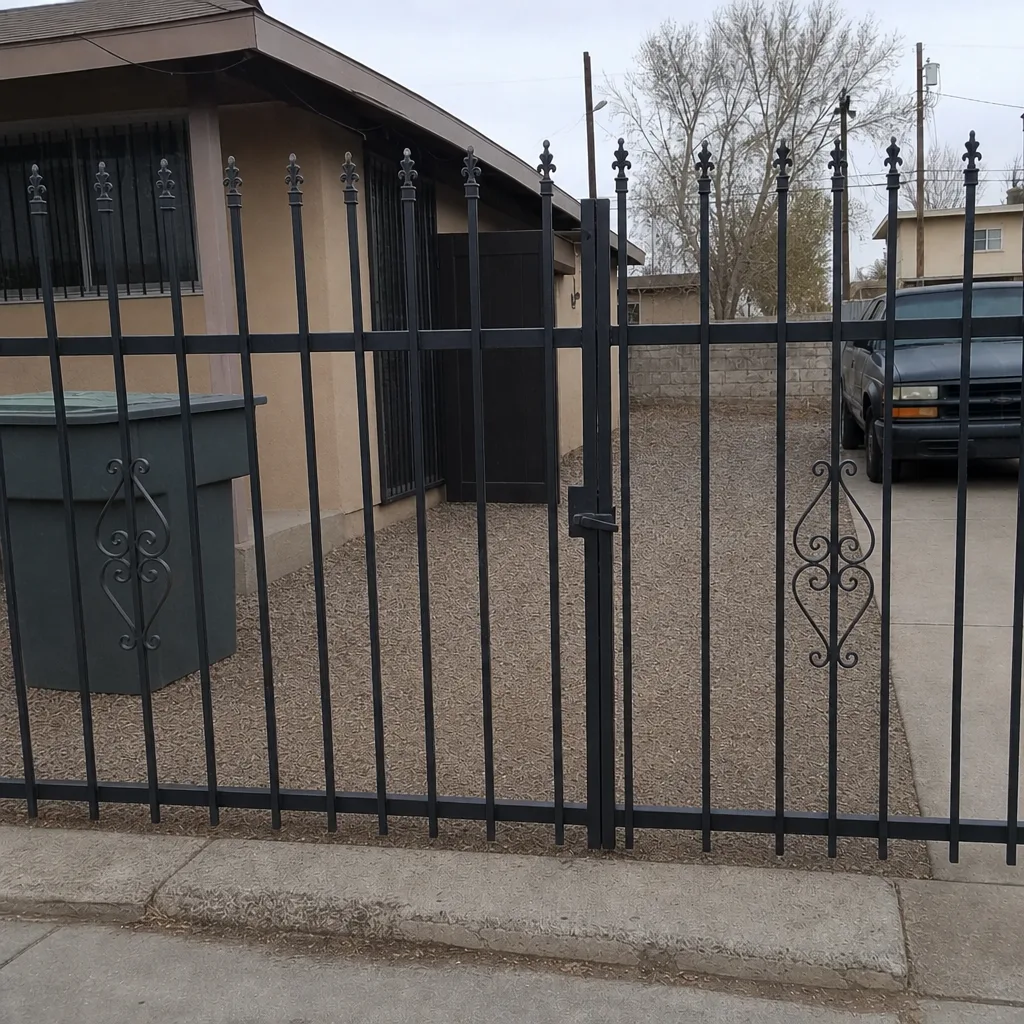
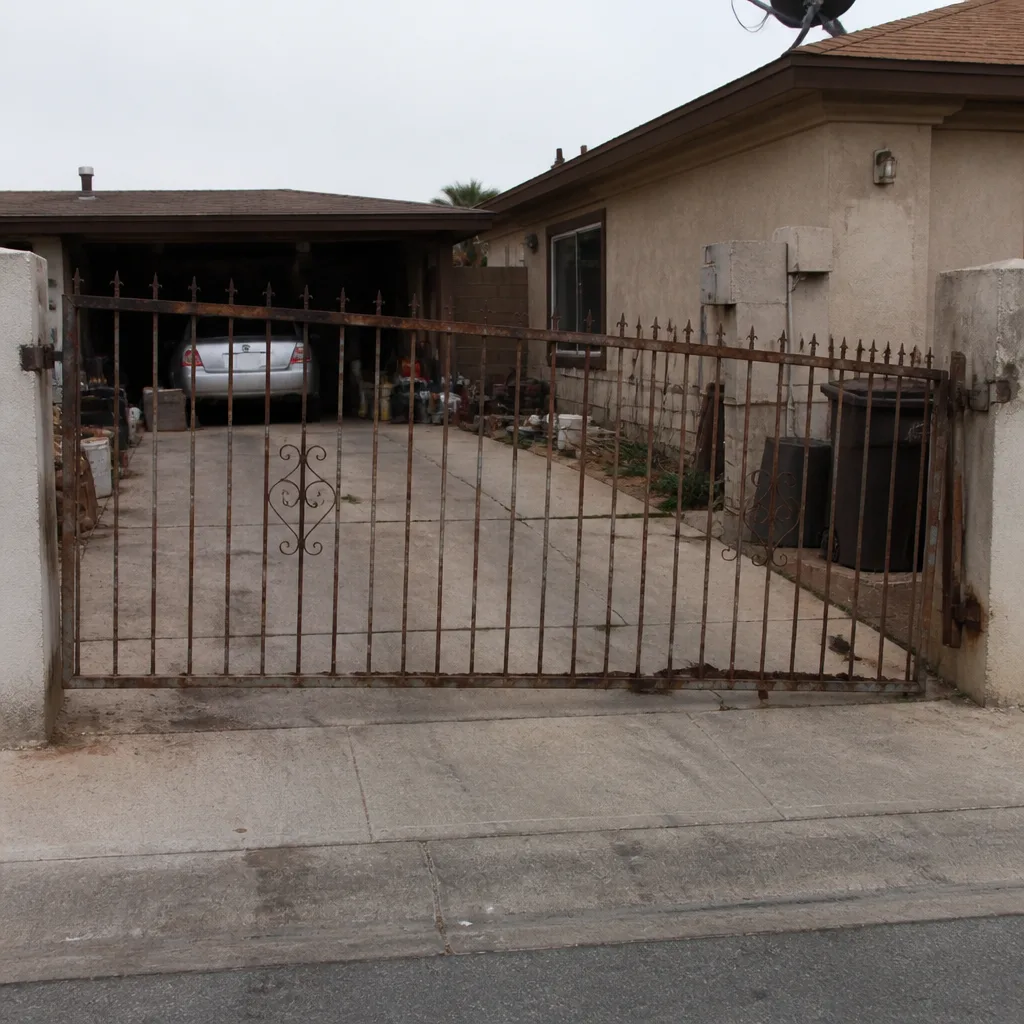
See the difference
 Before
 After
 Before
 After
 Before
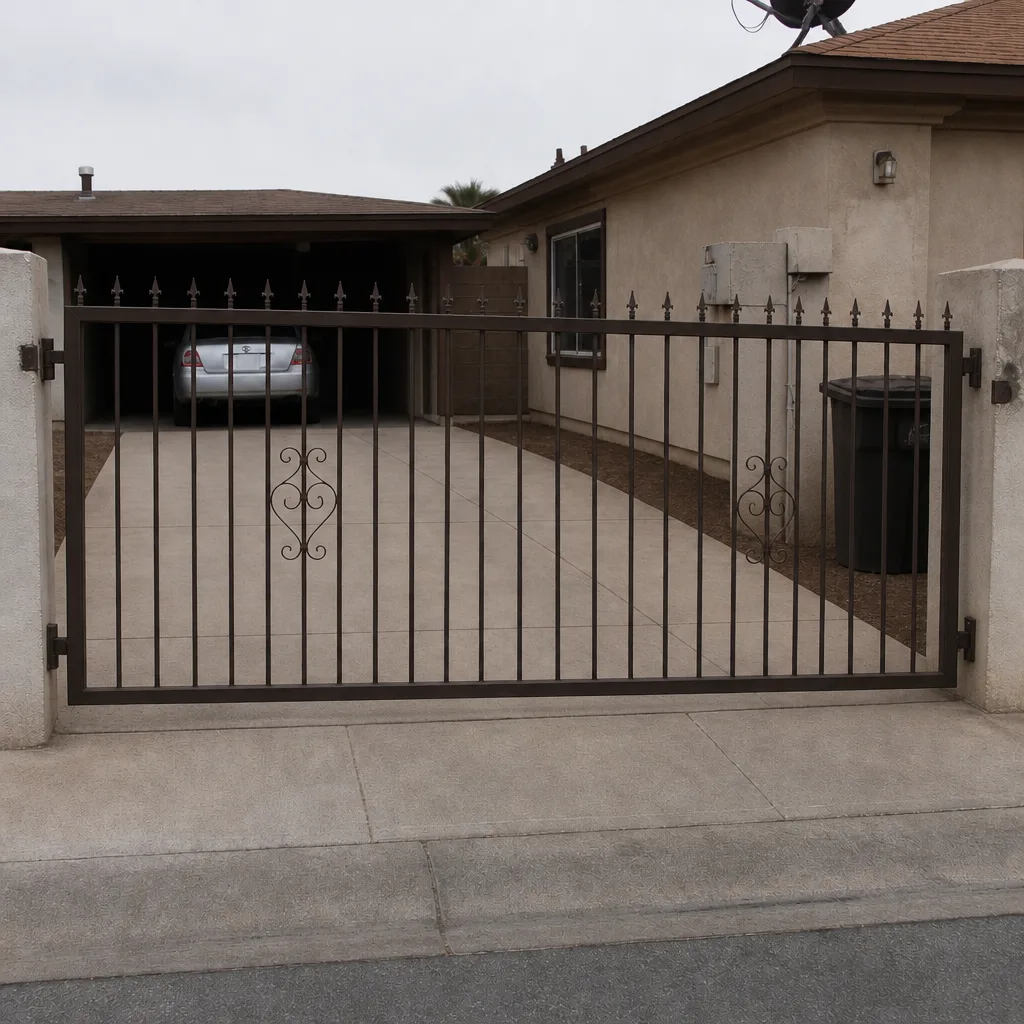 After
When to Call a Professional
Some of what’s on this list is homeowner work – hosing dust off, cleaning sensors, checking the manual release. Some of it isn’t. Call us before you touch anything that involves the high-tension springs on a swing gate, the electrical connections on the operator control box, or the structural footings on a caliche-ground post. Those aren’t DIY areas, and a mistake in any of them is a serious injury or a much bigger repair bill. Also call us if any of these come up: a gate that faults on cold mornings even after a fresh battery, a hinge post that’s visibly leaning, a weld that’s cracked at a hinge bracket, or a control board that’s failed after a summer of thermal shutdowns. In our experience, most of those are same-week fixes, and a lot of them are on-site welds we do in your driveway instead of hauling the gate off to a shop. Gatewood Fence & Gate North Las Vegas offers free estimates in North Las Vegas – call (844) 761-9351. Every job carries our 90-Day Done Right Promise in writing, so if something isn’t right, one call brings us back.
Frequently Asked Questions
Twice a year, ideally in April and October. The April service gets you ahead of the 100-degree summer, and the October service catches the heat damage and battery wear that summer causes. In between, a monthly sensor check during monsoon season (July through September) covers the rest.
Almost always the battery backup. Cold mornings below 45°F cut a lead-acid battery’s capacity by 30 to 40 percent, and if that battery was already weak from a summer of desert heat, the first cold snap pushes it under the threshold. Test the backup battery in October, and replace anything over three years old before December. If you want us to take a look, call (844) 761-9351 – estimates are free.
It creates a corrosion spike most homeowners miss. Dry dust settles into every hinge, weld, and bolt through July, then the first monsoon rain turns it into a wet paste that cakes on and eats the metal. Hosing the hardware down after storms and re-lubricating with a dry spray prevents most of the damage. If you find rust bloom on a weld, that’s worth an inspection – call (844) 761-9351 for a free second opinion on any written estimate.
Some of it, yes. Cleaning photo-eye lenses, hosing dust off the hardware, testing the manual release, and lubricating hinges with dry graphite are all homeowner-safe tasks. Anything involving the high-tension springs, the operator’s electrical wiring, or the post footings should go to a trained professional – those are the parts where a mistake causes serious injury.
Plan on $150 to $300 a year for the two key visits (April and October), depending on the gate size and operator type. That’s a fraction of one repair – a control board replacement runs $250 to $550, and an operator swap runs $700 to $2,000 or more. We quote and agree on every price before any work starts. Call (844) 761-9351 for an exact quote – estimates are free.
Yes, especially in caliche-heavy soil. Water trapped in the caliche cracks expands overnight and contracts mid-day, and over a winter of that cycling, a marginal footing can shift. If your gate starts self-closing or dragging in January or February, have the footing checked before you blame the hinges. Call (844) 761-9351 and we’ll come look – no trip charge inside the county.
The Bottom Line
North Las Vegas doesn’t have four equal seasons. It has April, summer, monsoon, and a short winter that surprises people who moved here from Phoenix. The April and October inspections are the two that matter, the monsoon monthlies are cheap insurance, and the winter checks on your battery and footings prevent the calls that always happen on the first cold morning. Do those, and your gate carries you through the year without a single emergency service visit. Skip them, and you’ll spend the same money on a repair that could have been a tune-up. If you’d rather have us handle it, call (844) 761-9351 – we answer 24/7, we publish our address, and our name is on the shop. Want the broader picture of what we do? Start at our Gatewood Fence & Gate North Las Vegas home page.
Written by the team at Gatewood Fence & Gate North Las Vegas.