
Last updated November 17, 2026
 Wrought iron
 Wood & steel frame
 Farm & ranch
 Sliding driveway gates
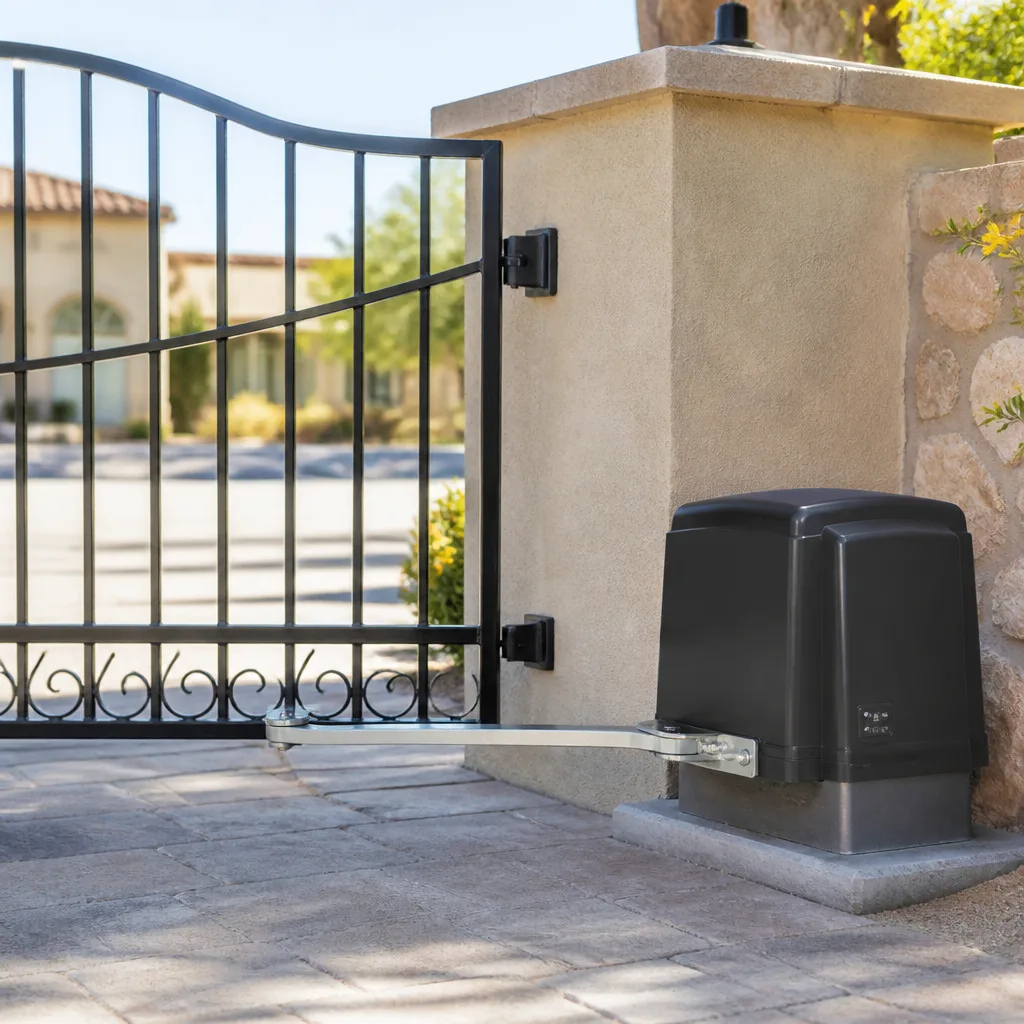 LiftMaster operators
Free on-site gate assessment - hinges, posts, and your LiftMaster or Nice gate operator checked before anything is quoted
The assessment is free and the quote is the invoice.
Get your free estimateGate Parts & Welding Maintenance Schedule: What to Do and When
The gap between your gate frame and post moves roughly 1/16 of an inch on a day that swings from 55°F to 95°F. Do that 200 times a year for 10 years and you’ve worked every fastener in that joint. That’s the thing most gate maintenance advice glosses over: metal in North Las Vegas doesn’t wear out on a quarterly calendar. It fails on a thermal-cycle schedule, and the worst of those cycles hit in late spring and late fall when the desert can’t decide if it’s cold or hot. This guide is built around that reality. You’ll learn what to check before summer heat locks in, what to look at once the furnace backs off, which jobs are eyes-and-hands-only and which need real tools, how to lubricate for dust rather than rain, and how to keep a gate log that saves you money the next time something breaks.
Quick Answer
Inspect a North Las Vegas gate at two key points each year: a pre-summer pass in late April or May focused on weld joints, hinge fasteners, and latch alignment before peak heat expansion, and a post-summer pass in October focused on paint and coating damage from UV exposure. Between those two visits, do eyes-and-hands checks monthly and a dust-specific lubrication routine about every six to eight weeks. Annual tasks that need tools (torque checks, weld inspection, hinge rebuilds) are best handled once a year by someone who knows what a failing joint looks like.
Styles & brands we work with
- Wrought iron
- Wood & steel frame
- Farm & ranch
- Sliding driveway gates
- LiftMaster operators
Table of Contents
- Why Gate Metal Fails on a Thermal-Cycle Schedule, Not a Calendar
- Pre-Summer Inspection: Weld Joints, Hinges, and Latches Before the Heat
- Post-Summer Inspection: Paint and Coating After UV and Heat Exposure
- Tools vs. Eyes-and-Hands: Which Tasks Belong to Which
- Lubrication Schedule for Desert Dust, Not Rain
- The Gate Log: The Cheapest Repair Money You’ll Ever Spend
- What a Full Year Looks Like, Month by Month
- Common Mistakes to Avoid
Why Gate Metal Fails on a Thermal-Cycle Schedule, Not a Calendar
Steel and aluminum expand when they warm and contract when they cool. In a mild climate the daily swing might be 15 degrees, so the metal moves a little and the fasteners take a gentle load. In North Las Vegas, a spring afternoon that hits 95°F can drop to a 55°F morning, and that 40-degree swing works the gate joints hard. Multiplied over a full season of swings, that’s thousands of small load cycles on every weld, bolt, and hinge pin.
What that means for you: the failure isn’t random. It clusters. The gate you walk past every day looks fine and then one afternoon in July the latch won’t catch because the frame has grown a hair in the heat and the post hasn’t moved. A hinge bolt that was snug in February feels loose by June. A weld that was sound in winter starts showing a hairline crack by fall because it took the summer’s expansion and contraction on a joint that was already slightly undercut.
We’ve seen this pattern over and over in the older neighborhoods around North Las Vegas, and it’s why a calendar that says “inspect in January” misses the point. The right timing is tied to the temperature swings, not the fiscal quarter. Two anchor inspections, timed to the swings, catch almost everything before it becomes a repair bill:
- Late spring (April – May): before peak heat expansion starts loading the joints.
- Late fall (October): after the summer’s UV and heat have done their work on coatings and paint.
Everything in between is maintenance. Everything at those two points is inspection, and inspection is where you find problems while they’re still cheap.
Pre-Summer Inspection: Weld Joints, Hinges, and Latches Before the Heat
This is the inspection that pays for itself. Do it in late April or May, before the sustained triple-digit stretch arrives, and you’re catching problems while the metal is still at its “resting” size. Here’s the order we work in, and the order we’d suggest you follow.
- Walk the whole gate and look at every weld. Run your eyes along the frame where horizontal rails meet vertical stiles, and where the hinge plates attach to the gate. You’re looking for a chalky line, a hairline crack, or a rust bloom where the paint has lifted. Any of those three means the weld took a load it didn’t like over the winter. Don’t grind or re-weld it yourself. Mark it and get it looked at.
- Check the hinge fasteners with a wrench, not your fingers. A hinge bolt that turns by hand is a hinge bolt that’s already loose. Snug it to spec, but don’t over-torque a bolt that goes into a hollow post – you’ll crush the wall and make it worse.
- Test latch alignment in the cool of the morning. If it latches cleanly at 7 a.m. but drags by 3 p.m., the frame is growing with the heat and the post isn’t. That’s a hinge or post issue, not a latch issue. Don’t “fix” the latch by adjusting the striker – fix the hinge or the post.
- Look at the hinge post itself. A gate sags in the hinge post, not in the middle. A post that’s leaning a half-degree shows up as a gate that drags its bottom rail. Check it with a level in two directions.
- Check the operator, if you have one. If your gate is on a Linear or Viking operator, watch the open and close cycle in the cool morning and again in the hot afternoon. Sluggish movement or a reversed safety edge that misfires only in heat is an operator problem you want to catch before summer.
If any of this sounds like more than you want to take on, that’s what we’re here for. Our Gate Repair in North Las Vegas service exists exactly for this kind of pre-season inspection, and the fix is usually smaller than people fear. Fix the panel without the post and you’ll fix it twice, so we start at the post.
Post-Summer Inspection: Paint and Coating After UV and Heat Exposure
North Las Vegas summers do two things to gate coatings. The UV bleaches and chalks the surface, and the heat drives solvent and moisture out of the coating until it’s brittle. What looks like “just faded paint” in October is usually a coating that’s lost its flexibility, which means it’s about to start lifting at the edges where the metal moves most.
This inspection is about catching that transition before the winter swings start flexing the coating off the metal. Here’s what to look at:
- Chalk test: run a clean white cloth along a horizontal rail. If it comes back with a heavy white powder, the topcoat is breaking down and needs recoating before winter.
- Edge check: run a fingernail along weld seams and hinge plates. If the paint chips off in flakes rather than scratching, it’s lost adhesion at that edge and will need to be feathered and recoated.
- Rust bloom: small orange spots, especially on the underside of the bottom rail and around the hinge bolts, mean moisture has found bare metal. Rust under paint spreads sideways faster than you’d expect.
- Fastener paint: bolts and hinge pins painted over in a prior touch-up often crack around the head. That cracked paint holds moisture against the fastener and starts a corrosion point.
- Post base: check the concrete at the base of each post for a rust ring. That’s a sign moisture is wicking up into the post from below.
October is the right month for this because the temperatures are low enough for coating to cure properly and high enough to apply it comfortably. If you paint in July, the coating skins over before it bonds and peels by spring. If you wait until December, the cold nights slow the cure and the finish goes soft. The two-to-three-week window on either side of Halloween is the sweet spot in North Las Vegas, and it’s why the fall inspection matters as much as the spring one.
Tools vs. Eyes-and-Hands: Which Tasks Belong to Which
Not every maintenance task needs a toolbox, and knowing the difference keeps you from either under-maintaining the gate or tackling a job you shouldn’t. Here’s the split we use.
Eyes-and-hands tasks (monthly)
- Walk the gate and open/close it by hand, feeling for drag or binding.
- Run a hand along weld seams to feel for a proud or rough spot that suggests a crack starting.
- Wiggle each hinge and latch by hand – if a joint that was tight has play, note it.
- Look at the latch in the cool morning and again in the hot afternoon to check alignment drift.
- Spot-check for new rust blooms, paint flaking, or a shifted post base.
- Watch an operator’s full cycle and listen for a new rattle or hesitation.
Tool tasks (annual, or as needed)
- Torque-check the hinge plate bolts and the post anchor bolts with a wrench.
- Inspect welds for hairline cracks that need to be ground out and re-welded on site.
- Rebuild or replace a hinge that’s taken a permanent set.
- Reset a leaning hinge post (a job that usually involves digging and re-setting, not just tightening a bolt).
- Recoat or repaint with proper surface prep.
- Adjust or service an operator, including limit switches and safety edges.
The rule of thumb: if a task requires loosening a bolt, moving a post, or touching a weld, it’s a tool task. If it requires looking, feeling, or comparing morning to afternoon, it’s an eyes-and-hands task. The second category is where you catch problems early. The first category is where the actual fix gets made, often by someone with a truck, a welder, and 25 years of practice.
Lubrication Schedule for Desert Dust, Not Rain
Most lubrication advice you’ll find online was written for wet climates. It assumes the enemy is water, so it recommends heavy grease and a thick coat to seal out moisture. In North Las Vegas the enemy is dust, and heavy grease is a dust magnet. A thick coat of axle grease on a gate roller in a dusty neighborhood turns into a grinding paste within six weeks and wears the roller out faster than no lubrication at all.
The right products for a dusty gate:
- Dry PTFE (Teflon) spray for hinge pins, rollers, and latch mechanisms. It goes on wet, dries to a film, and doesn’t collect dust. This is the workhorse.
- Silicone spray for rubber seals and safety-edge strips on operators. It keeps them pliable without attracting grit.
- White lithium grease for the operator’s drive screw, if the manufacturer calls for it. Apply sparingly, and wipe off the excess rather than leaving a visible coat.
- Graphite powder for lock cylinders. It lubricates without trapping dust.
What gums up fast in Nevada: heavy axle grease, WD-40 used as a long-term lubricant (it’s a solvent, not a lube, and it attracts dust once it dries), and any spray labeled “rust preventative” that stays tacky to the touch. If it’s tacky, dust sticks to it, and stuck dust wears metal.
The schedule: every six to eight weeks in the dusty season (spring through early summer, when the wind gets up), and every ten to twelve weeks in the calmer months. Wipe joints clean with a dry rag before you lubricate – spraying over a dusty joint just packs the grit in. Don’t oil before a forecast wind event; you’ll get a nice even coat of grit that afternoon. If you’re on a DoorKing or Ghost Controls operator, check the manual for any drive components that need a specific product – the manual wins over any generic recommendation, including ours.
The Gate Log: The Cheapest Repair Money You’ll Ever Spend
A gate log is a small notebook, a note on your phone, or a sheet of paper taped inside the garage door. It records what you checked, when, what you found, and what got fixed. Its job is to make the next repair faster and cheaper – and it does both.
Here’s what to log:
- Date and temperature (rough is fine) for every inspection. This is what lets you spot thermal patterns later.
- What you checked – a one-line list is enough.
- Any play, drag, rust, or misalignment you noticed, even if you didn’t fix it. “Right hinge has a little play, cool morning, 62°F” is a useful entry.
- What got fixed and by whom, with the date and the invoice tucked into a pocket in the notebook.
- Operator fault codes if you get any. Write down the code and what the gate was doing when it flashed.
Why this matters: the person who fixes the gate can’t feel what you felt six months ago, but they can read it. When we walk up to a gate and the owner hands us a log that says “left hinge started dragging around mid-June, latching fine in the morning, sticking by 3 p.m.,” we know exactly what to look at first. That saves diagnostic time, which saves you money. It also saves the guessing that leads to swapping parts that don’t need swapping. For a gate on an older LiftMaster or FAAC operator, a log of fault codes and symptoms often tells us what to bring in the truck before we leave the shop.
What a Full Year Looks Like, Month by Month
Here’s the calendar we use for North Las Vegas gates, tied to the temperature swings rather than the seasons. Adjust slightly for your specific exposure – a gate on the west side of a wall that bakes all afternoon takes more heat than one in shade – but the shape of the year holds.
- January – February: eyes-and-hands walk-through once a month. Cold mornings are a good time to feel for hinge play; the metal is at its smallest and any looseness shows up clearly.
- March: pre-season lubrication. Wipe joints, apply dry PTFE, and do a full visual check of the welds now that the paint has dried from winter.
- Late April – May: pre-summer inspection. Weld joints, hinge torque, latch alignment, post plumb, operator cycle check. This is the big one.
- June – August: eyes-and-hands walk-throughs every two to three weeks. Don’t wrench anything – just watch and note. Any work that needs tools waits until the heat backs off unless it’s a safety issue.
- September: late-summer lubrication pass. Clean and re-apply PTFE before the fall wind kicks up.
- October: post-summer inspection. Paint and coating checks, rust blooms, and recoating if needed. This is also when we catch most of the weld cracks from the summer’s expansion load.
- November – December: eyes-and-hands checks, and a wrap-up log entry summarizing the year. If you’re going to budget for a repair, budget it now.
That’s eight to twelve short walk-throughs a year and two real inspections. Total time: maybe four hours over twelve months. Compare that to a gate replacement, which is a much bigger line item. The math almost always favors the calendar.
Common Mistakes to Avoid
- Adjusting the latch to fix a sagging gate. The latch is a symptom, not a cause. If the gate sags, the problem is in the hinge post or the hinge plates, and adjusting the striker just buys you a few weeks before the gate misses again.
- Greasing the gate like it’s a tractor. In North Las Vegas dust, a thick coat of grease turns into a grinding paste. Dry film lubricants win every time.
- Painting in the middle of summer. Coating applied at 105°F skins over before it bonds, and it peels by the next spring. Paint in October.
- Ignoring a hairline crack at a weld. A small crack in a loaded weld propagates faster than people expect. Grind it out and re-weld it now, or it becomes a broken joint later.
- Bolting a new hinge to a failing weld plate. If the plate is cracked, a new hinge just breaks the same weld again. Fix the plate first.
- Wrenching on a hot afternoon. Metal is expanded, torque readings are off, and you’ll over-tighten done snug in the morning. Do tool tasks in cool hours.
- Running an operator gate with a manually-dragging gate. A gate that won’t swing by hand without drag will burn out the operator. Fix the gate, then the operator. That’s why our Gate Motor & Opener in North Las Vegas service starts with the swing test, not the motor.
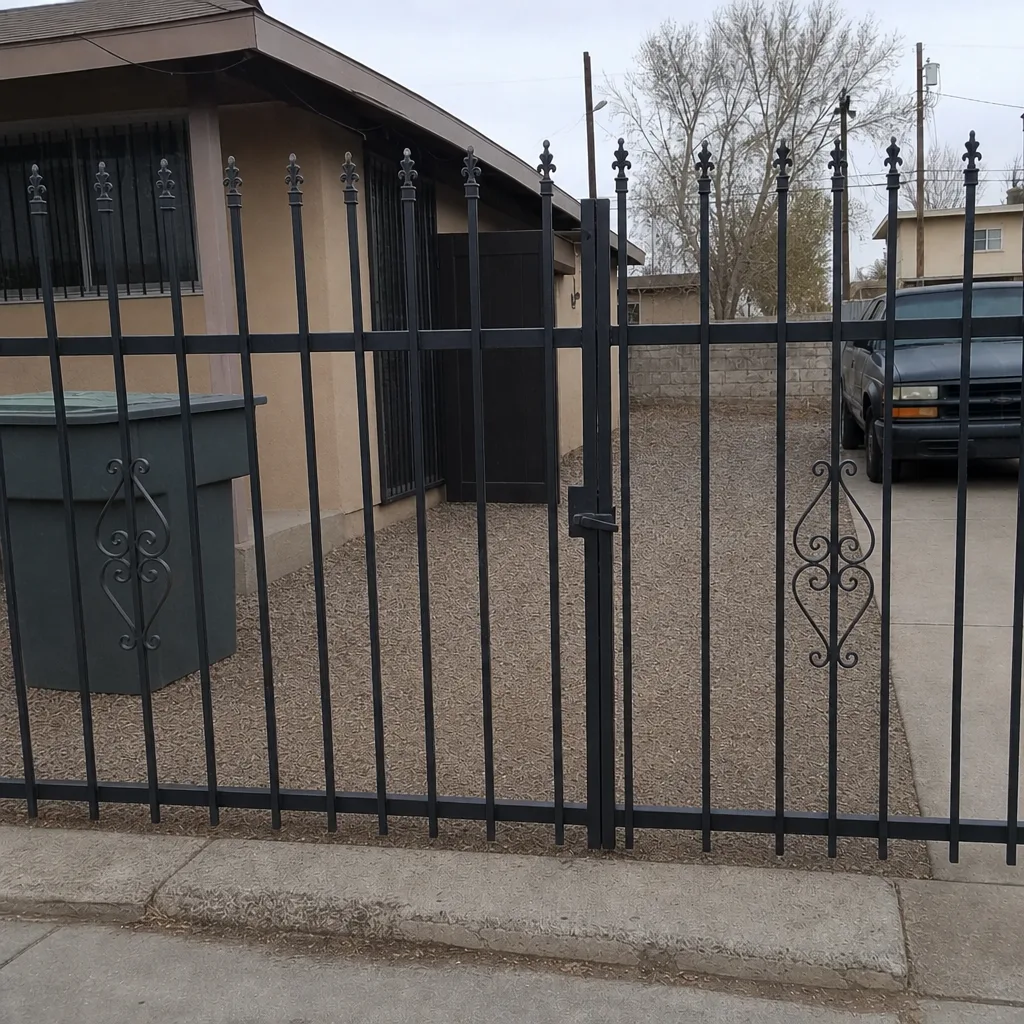
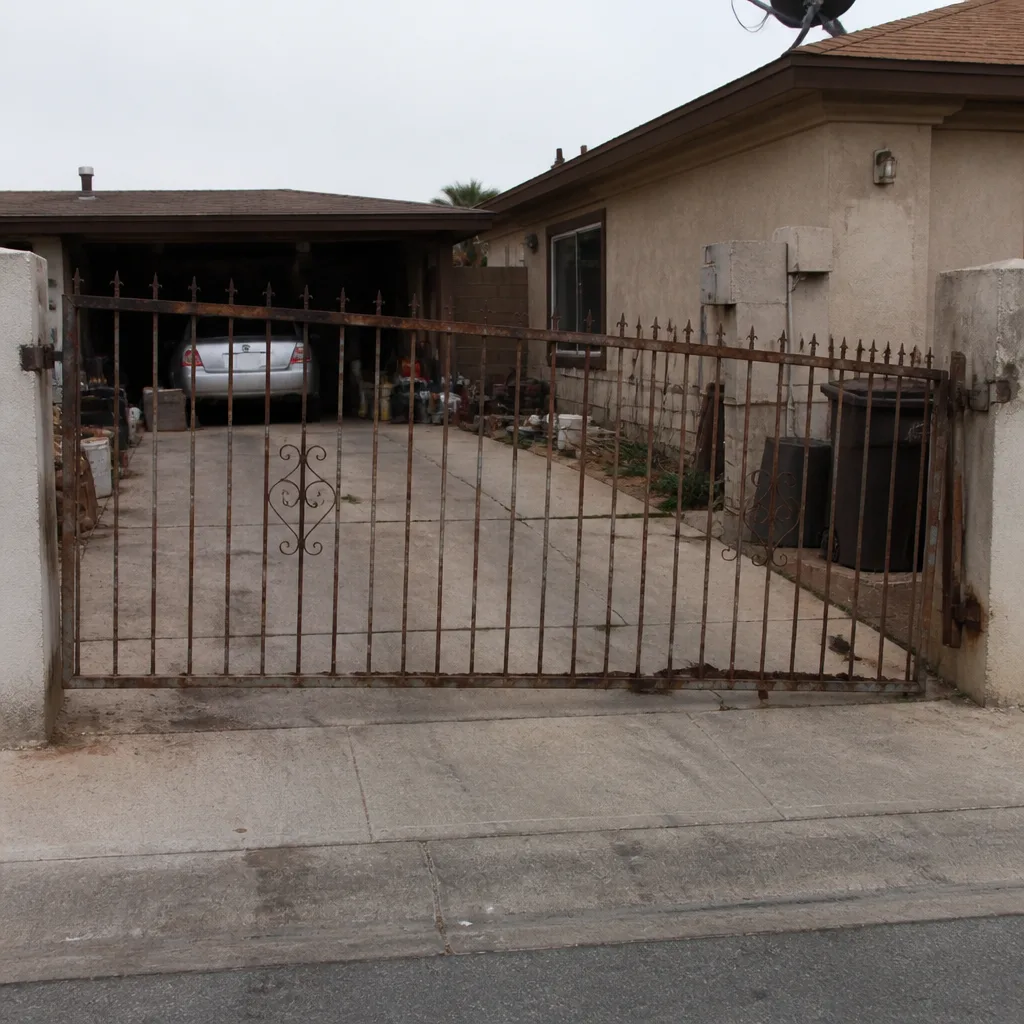
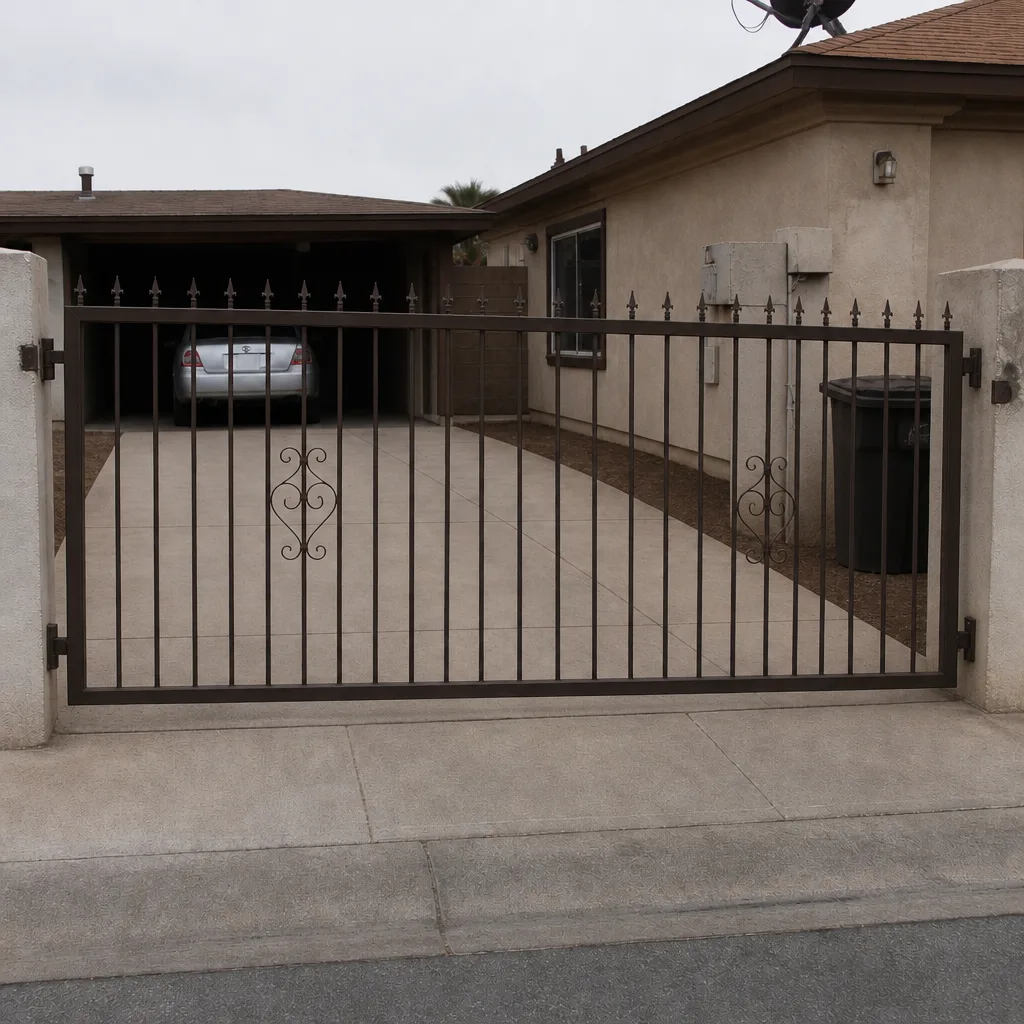
See the difference
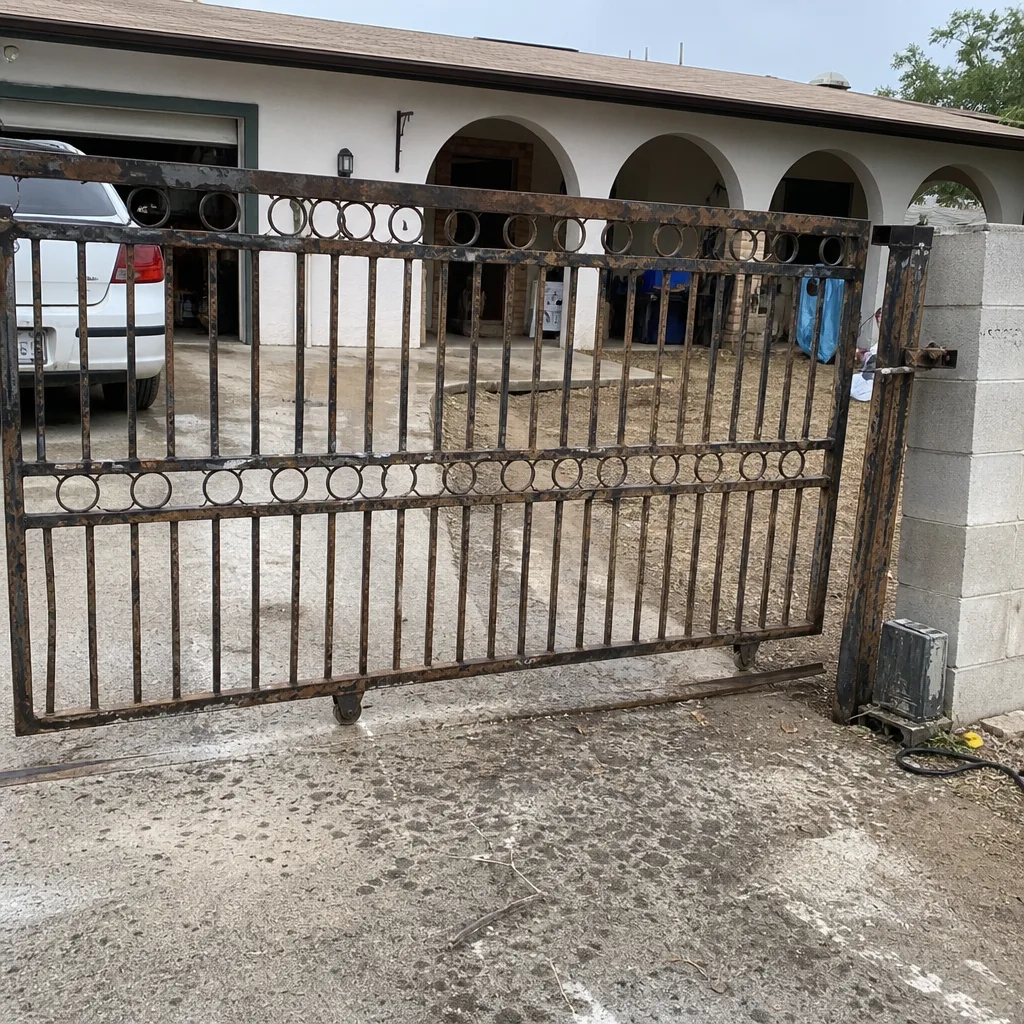 Before
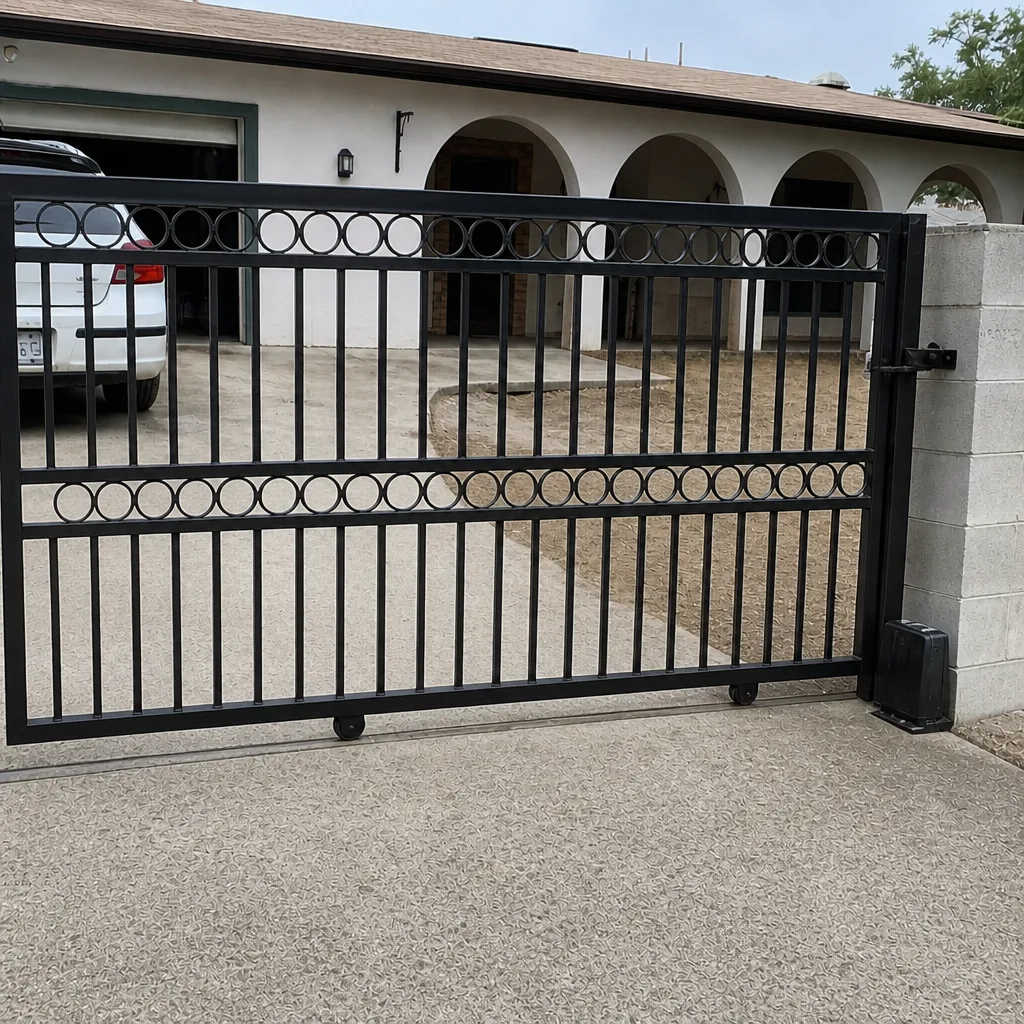 After
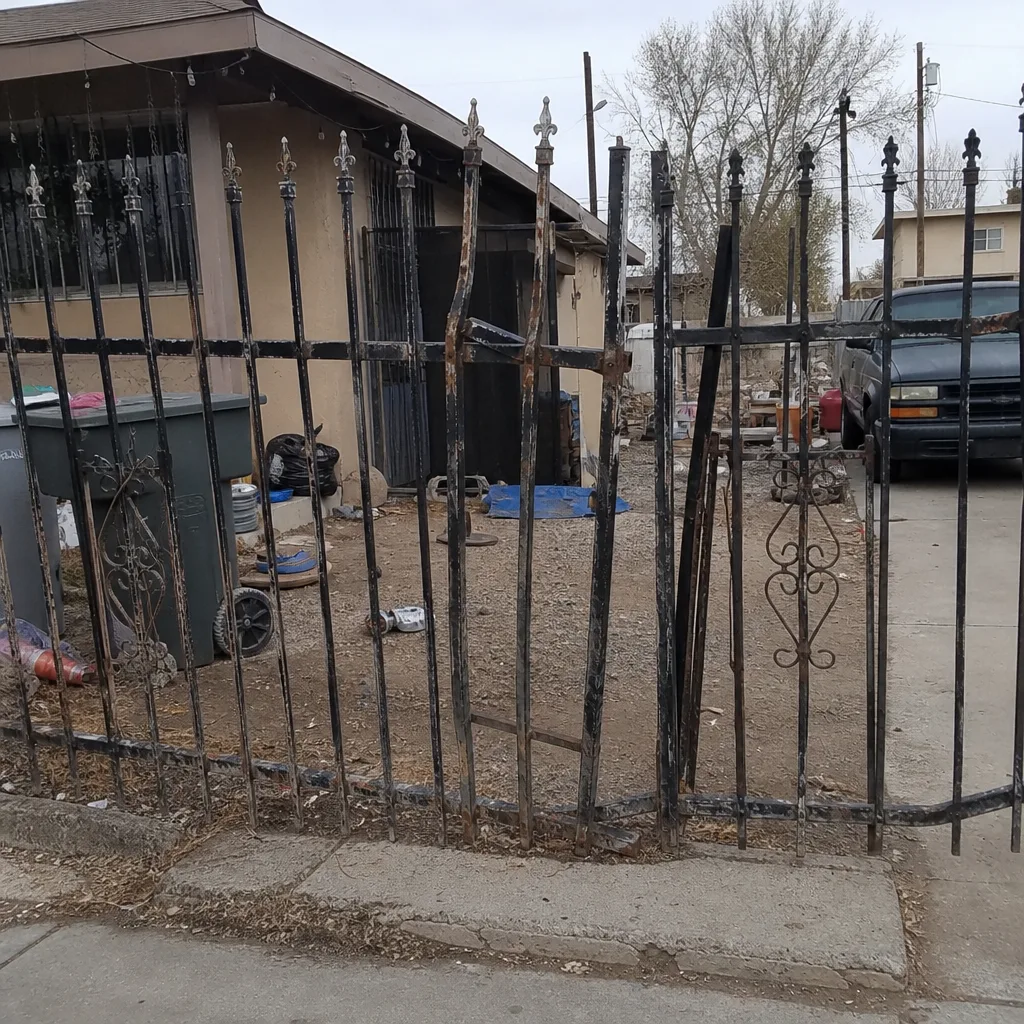 Before
 After
 Before
 After
When to Call a Professional
Some jobs belong in your hands and some don’t. Call us for anything involving a weld, a leaning post, a hinge rebuild, an operator that won’t run right, or a gate that has suddenly stopped latching cleanly. Call us before you paint if the coating is chalky or flaking, because surface prep matters more than the paint. And call us if the gate log shows the same problem more than once – a recurring fault is a real problem asking to be fixed properly.
Here’s the safety piece, and we won’t soften it: springs, tensioned hardware, and overhead weight are genuinely dangerous. A gate spring under load can do serious injury in an instant, and a gate on an operator can move without warning. Don’t take a spring or tensioned assembly apart on your own. Don’t weld near anything that’s under load. If a hinge is failing and the gate is starting to lean toward the drive, get out from under it and call.
Gatewood Fence & Gate North Las Vegas offers free estimates in North Las Vegas – call (844) 761-9351. We do on-site welding, which means the gate stays in your driveway instead of getting hauled off. Every job carries the 90-Day Done Right Promise in writing, and a live person answers the phone around the clock. If you’ve been burned by a national outfit that quoted one price and charged another, bring us the written estimate and we’ll give you a free second opinion on it. Our technicians have up to 25 years of experience, and the person who shows up is the same one who does the work. For the full picture of what we do, start at the Gatewood Fence & Gate North Las Vegas home page.
Frequently Asked Questions
Twice a year in detail (late spring and October) plus a monthly eyes-and-hands walk-through. The two big inspections are timed to the temperature swings, not the seasons, because that’s when the metal takes the most load. If your gate is on the west side of a wall that gets full afternoon sun, consider adding an extra walk-through in mid-summer. Call (844) 761-9351 if you want us to do the detailed inspection for you – estimates are free.
A gate sags in the hinge post, not in the middle. Either the post has settled or leaned, or the hinge plates have worked loose, or the hinge pins have worn. In our experience most sagging gates are fixable with a post reset and a hinge rebuild – the gate itself is fine. We’ll tell you honestly if that’s not the case. Call (844) 761-9351 to book an assessment.
Dry PTFE spray for hinge pins and rollers. It goes on wet, dries to a film, and doesn’t attract dust. Silicone spray for rubber safety edges, graphite powder for lock cylinders, and white lithium grease only where the operator manual specifically calls for it. Heavy axle grease is the wrong tool in North Las Vegas dust – it becomes grinding paste. Call (844) 761-9351 if you need a recommendation for your specific operator brand.
October, ideally in the two or three weeks on either side of Halloween. Summer is too hot (the coating skins over before it bonds) and December nights are too cool (the finish goes soft). Watch for the chalk test and edge flaking in your post-summer inspection, and recoat before the winter temperature swings start flexing the old coating off the metal. Call (844) 761-9351 for a coating assessment.
Yes. A small crack in a loaded weld propagates faster than most people expect because every thermal cycle opens it a little more. On a North Las Vegas gate, that’s 200-plus cycles a year. Grinding out and re-welding a hairline crack is a small job; fixing a broken joint that’s taken the post with it is a much bigger one. On-site welding is one of our core services. Call (844) 761-9351.
Yes, and it’s the cheapest thing you’ll do all year. Log the date, the rough temperature, what you checked, and any play, drag, or misalignment you noticed – even if you don’t fix it yet. When a technician walks up with your log, they know what to look at first, which saves diagnostic time and money. Keep the invoices tucked in the same notebook. Call (844) 761-9351 if you want us to start a log for your gate on our first visit.
The Bottom Line
Gate maintenance in North Las Vegas isn’t about following a generic quarterly calendar – it’s about riding the thermal cycles. Do a real inspection in late spring before the heat loads the joints, and another in October after the summer has done its work on the coatings. Between those two visits, monthly eyes-and-hands walk-throughs plus a dust-specific lubrication pass every six to eight weeks will catch almost everything before it becomes a repair bill. Keep a log, and the next person who works on your gate will thank you with a smaller invoice. If you’re looking at a hinge issue, weld, or a sagging post, that’s where we come in. For a fresh install or a bigger project, see our Gate Installation in North Las Vegas page. If your gate is on an operator and you’re wondering whether it needs a service, call us for a swing test. The name is on the shop, and the shop is down the road – that’s the oldest accountability there is.
Call (844) 761-9351 for a free estimate. No trip charge inside the county, $40 off any repair over $200, a free second opinion on any written estimate, and a permanent 10% discount for seniors and veterans. Estimates are always quoted and agreed before any work starts, and every job carries the 90-Day Done Right Promise in writing.
Written by the team at Gatewood Fence & Gate North Las Vegas.